Content licensing administration · Passenger vessels · Europe
European content licensing for passenger vessels, handled through one point of contact.
Broadcast content lawfully received aboard is often redistributed to cabins and public areas. That redistribution can require its own licences, across several rights categories and territories. Clara establishes what actually applies, and administers it.

Could this apply to your vessel?
Do you distribute TV or radio from a central onboard system to passenger cabins or public areas?
Does the vessel operate in European jurisdictions?
Do your existing agreements expressly include the onward redistribution rights?
Yes, or unsure? A confidential intake establishes whether a full assessment is warranted. Thirty minutes, no cost, no obligation.
The storyline, condensed.
Content arrives
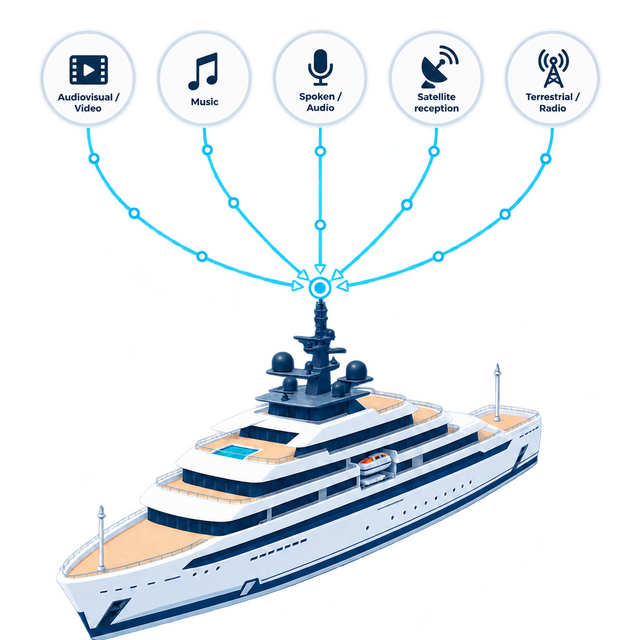
A television channel carries more than one underlying right.
The vessel receives it

Subscriptions and supplier contracts cover access to the signal.
The vessel redistributes it
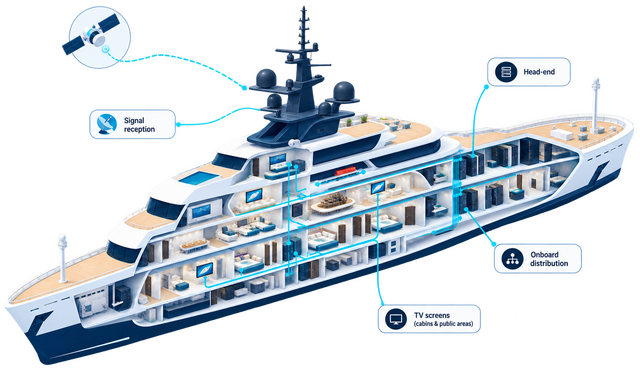
One head-end feeds many cabins and public screens. A separate act.
Rights arise

Musical works, neighbouring rights where applicable, audiovisual works, broadcaster-held rights.
Territories multiply it

The content stays the same; the framework beneath the vessel changes.
What Clara does.
Assess
The vessel’s actual position is established first: channels, territories, existing agreements, existing licences.
Clear
Only the gaps are licensed. Existing coverage is respected, not duplicated.
Administer
Renewals, reporting, itinerary and channel changes, handled continuously.
What you receive
The Licensing Obligations Report.
Every channel mapped against the rights categories. Every territory on the itinerary mapped against the applicable licences. Existing coverage identified, each gap identified, and indicative costs where tariffs allow. A document your board, your insurer, and your lawyer can each read. The report is yours whether or not Clara is engaged further.
Why maritime is complicated.
Several rights categories, administered by different organisations. Several territories, each with its own framework. A moving operation, so the applicable framework changes while the content does not. Channel line-ups that change season to season. And supplier agreements written for signal access rather than redistribution. None of this is unmanageable; it is administration, and administration is what Clara does.
Cost predictability.
Collective-management costs are generally based on applicable published tariffs, which makes a large part of the licensing budget predictable in advance. Rights requiring direct clearance are budgeted separately. The assessment establishes the likely exposure before anything is implemented, and existing licences are reviewed before any additional right is cleared.
Legal foundation
Established principles, applied to maritime redistribution.
The CJEU has repeatedly held that deliberate redistribution of broadcast content to successive guests can constitute communication to the public. No judgment yet concerns passenger vessels specifically; Clara applies the Court’s established criteria to the equivalent onboard redistribution model.
Foundation: CJEU C-306/05 (SGAE) and successor jurisprudence; Directive 2001/29/EC; Directive (EU) 2019/789.
Read the legal basisSectors.
River cruise
Weekly itineraries crossing several Member States; each run engages multiple national regimes.
Ocean cruise
Integrator content deals frequently leave the redistribution layer unaddressed.
Overnight ferries
Crew-area licences normally do not extend to passenger cabins.
Superyacht
Charter operation is commercial operation; guest cabins engage the same framework.
Offshore
Crew welfare systems bring content aboard; redistribution to crew cabins engages the same framework.
Other sectors
Another vessel type?
The framework is vessel-agnostic. If your vessel redistributes broadcast content to cabins, the same intake applies; enquire directly.
What applies to your vessel.
Thirty minutes, confidential, non-binding. No obligation to commission an assessment, and no obligation to engage Clara for any subsequent licensing. The conversation establishes whether there is a question worth assessing at all.
Book a confidential intake